why we miscommunicate: a stress test for truth
We rarely fight about the words. We fight about the worldview underneath them. Miscommunication grows when we protect our filters instead of the truth.

Yesterday, I posted a thread that I thought would be a great opportunity to talk about different communication styles. I wrote:
Someone replied to my thread and said:
“Short-form communication can be very effective in impactful persuasion. Consequently, it can also be a very effective tool for manipulation. This is especially true if people discount the necessity of long-form explanations for complex ideas.”
Now, you might be thinking:
Both of these things can be true.
And they can.
But these are exactly the moments where miscommunication takes root—not because anyone is wrong, but because both of us are speaking from completely different echo chambers.
Not political echo chambers—cognitive ones. Emotional ones. The internal worlds we build around what we believe keeps us safe, respected, or understood.
This isn’t a story about who was right.
It’s a story about how two people can be talking about the same topic while defending entirely different truths.
Follow me on TIKTOK or IG for more videos like these.
what’s said, what’s meant, and what’s heard
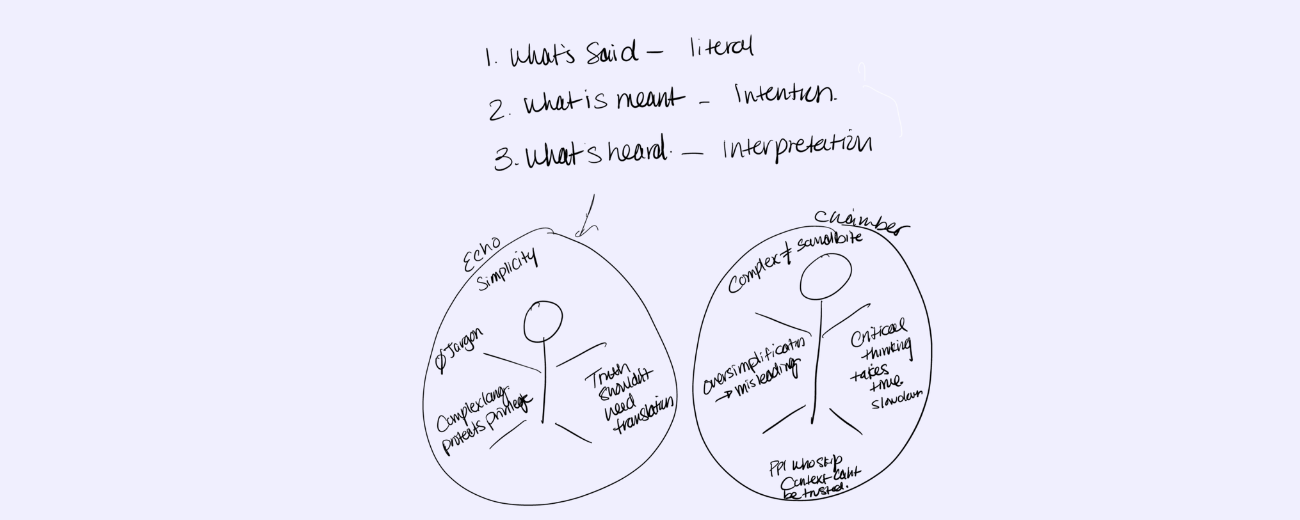
Every communication has three layers:
- what is said — the literal words
- what is meant — the intention behind the words
- what is heard — the interpretation shaped by the listener’s lens
The gap between intention and interpretation creates 90% of our conflict.
And that gap is carved out by our echo chambers—the mental environments that repeat and reinforce what we already believe.
my echo chamber (quoted exactly from my script)
Right now, and this changes, I value simplicity. I don't like jargon. I oftentimes believe that complex language protects privilege and that truth shouldn't need that much translation.
My emotional driver is:
a frustration with elitism
and exclusion in spaces that prize intellectual posturing over understanding; spaces where people want to look smart more than they want to help others understand.
Because of that emotional driver, I carry a bias:
complexity sometimes equals ego.
I often think very smart people are talking to other very smart people instead of the people who actually need to learn what they have to share.
There’s a risk in this bias:
I can undervalue nuance and detail, even though nuance and detail protect against misinformation.
their echo chamber (quoted exactly from my script)
From their response, I can reasonably assume their chamber is shaped by beliefs like:
- complexity cannot be boiled down to a soundbite
- oversimplification can be misleading
- critical thinking takes time and we need to slow down
- people who skip context cannot be trusted
Their emotional driver might be:
a fear of manipulation and propaganda and viral misinformation.
Their bias might be:
length sometimes equals depth
or
simplicity equals risk.
And there’s a risk for them, too:
They may mistake many words as thoughtfulness
and alienate people who crave plain language.
different chambers, same priority
We have wildly different echo chambers.
Wildly different emotional drivers.
Wildly different communication instincts.
But we share one thing:
We both care about the truth.
My thread shows I care that truth lands—that it has impact.
Their reply shows they care that truth expands—that it has precision.
My echo chamber protects against exclusion.
But it risks oversimplification.
Their echo chamber protects against manipulation.
But it risks alienation.
Most disagreement isn’t about the topic.
It’s about what each person is protecting underneath the topic.
the four truths at the heart of this
We enter conversation trying to protect something.
The other person is doing the same.
If you can name what feels threatened in you—and imagine what feels threatened in them—the whole tone shifts. Communication moves from defensiveness to curiosity.
Every person mistakes their filter for reality.
In this exchange, I value access. They value precision. Both are incomplete on their own, and both are legitimate. This is why thinking better requires holding multiple truths at once.
The smarter we are, the more elegantly we justify our bias.
Intelligence without humility builds walls. We end up using logic to self-confirm instead of self-check. The question that exposes whether we’re falling into this trap is:
“Am I explaining this to explore or to prove I’m right?”
And finally, before we jump in with certainty, we should ask:
“What kind of mind does this moment call for?”
A fast mind or a slow mind?
A mind of clarity or a mind of complexity?
Because the deeper question—the truth-testing question—is this:
“Can I hold someone else’s way of seeing without collapsing my own?”
If the answer is yes, we move toward wisdom.
If the answer is no, we move toward walls.
Truth is expansion, not possession.
It does not live in the center of one thread or one worldview.
It lives in the space where multiple views can stand without destroying one another.
That space is where thinking sharpens.
Where understanding grows.
Where conversations stop being warzones and become opportunities.