the system doesn't need to censor you
It trained you to do it yourself.

We are being flooded with information. And yet I keep having the same conversation with people I live near, work with, love.
"Haven't you seen?" I ask.
"No. I haven't watched that. Where did you see it?"
The past few weeks I was going through the Epstein files. Documents from the Jeffrey Epstein case, released publicly after years of being sealed. Millions of pages. Now sitting on a government website. Available to anyone willing to look.
I found myself wanting to share some of what I was reading. And hesitating. Not because I doubted the documents were real. Because what was in them was so charged, so long labeled dangerous to repeat, that my body treated sharing it the same as spreading conspiracy. Even with the files open in front of me.
I care about how I'm perceived. I'm building something around being credible, measured, serious. And in that moment, my reputation mattered more to me than the truth sitting on my screen.
I got curious about that. Not the content of the files. The mechanism in me. The training that made my first instinct, when confronted with documented evidence, not to share it but to protect my image.
The system does not need censorship. It needs you to censor yourself.
Think about the last time you scrolled past something that should have stopped you.
Something real. A headline. A video that started playing before you could decide whether to watch. Something entered your body, a flicker, a tightening, the beginning of a feeling, and then your hand kept moving.
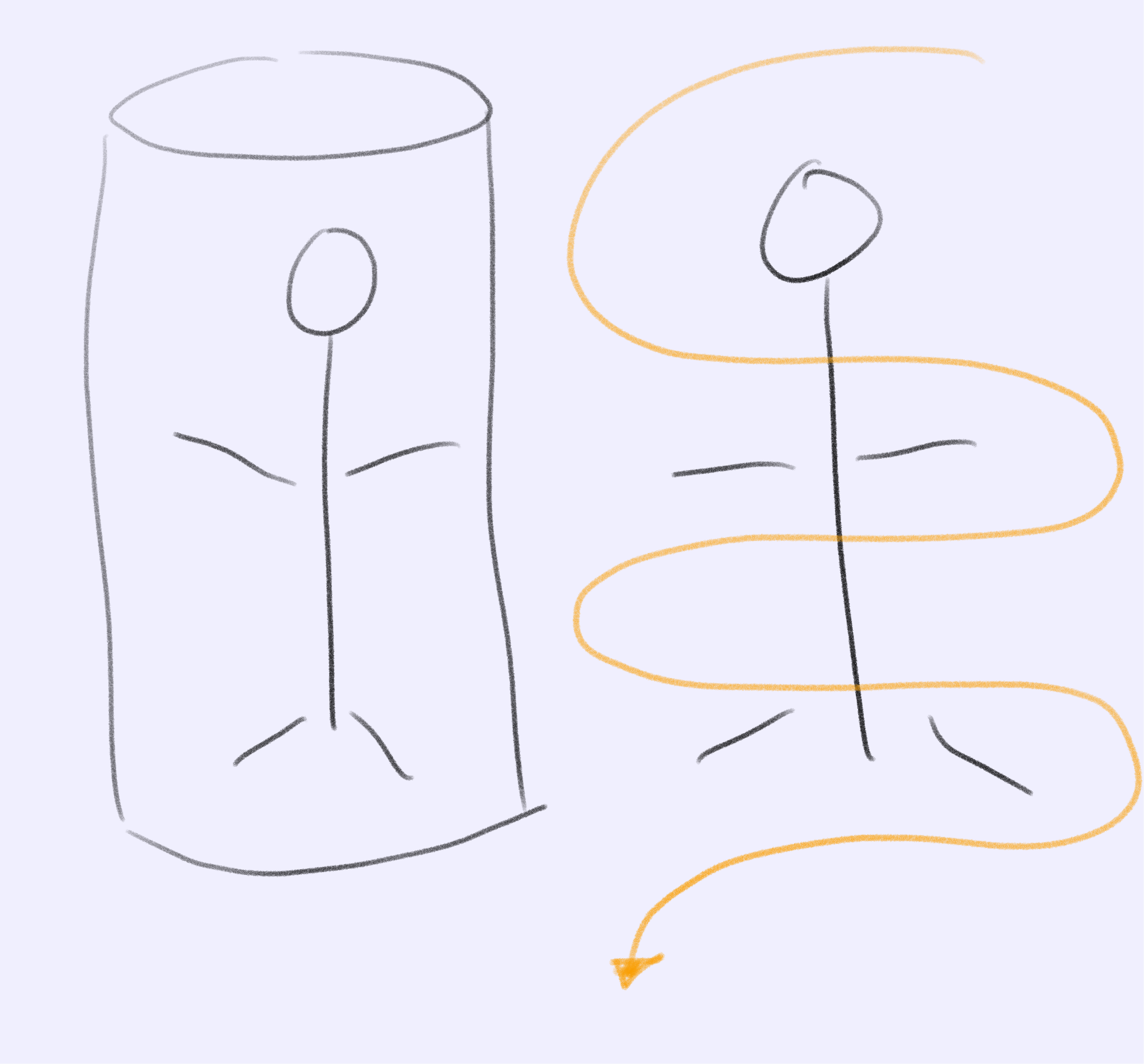
You didn't decide to keep scrolling. Your hand just continued. The feeling that started to form got cut off mid-arrival. Not denied. Interrupted. Like hanging up on a call before the person finishes their sentence.
You probably did that today. If you're reading this on a screen, you did it on the way here.
What does it actually feel like when something lands?
Not when you form an opinion. When it lands. In your chest. In your stomach. In the part of you that doesn't have language yet.
The ground shifts. Not dramatically. Just enough that the version of reality you were operating inside no longer holds. You feel slightly different in your own body. Slightly less able to continue as if everything is fine.
Once something lands, really lands, you cannot pretend you don't know. You have to speak differently. Act differently. You become someone who carries this now.
So the body learns, early and well, to interrupt the landing.
You feel the beginning of the feeling. You register that something is there. But you don't let it complete. You move past it before it can reorganize you.
You've practiced this so many times it feels like personality. "I'm just not that emotional." "I don't let things get to me."
It feels like nothing. And nothing is the point.
One person doing this changes nothing. Millions doing it at the same time changes everything.
Outrage never synchronizes. Pressure never builds. Each person thinks they are coping. Together, they are keeping the structure exactly where it is. The structure that needs your numbness to function. The structure that profits from your inability to feel long enough to act.
The system does not need silence enforced from above. It needs millions of people whose bodies have learned to interrupt their own response before it becomes action.
You are already pulled out of your body most of the day.
Earning a living. Managing perception. Navigating workplaces. Calculating how you're being seen. Performing energy you don't actually have.
When you live in your head long enough, you lose fluency with what your body is telling you. Sensation becomes background noise. Or it becomes constant noise, anxiety that never resolves into action, a body that feels everything and finishes nothing.
If you're already pulled out of your body, you can scroll through a document that describes the trafficking of children and feel almost nothing. Not because you don't care. Because the feeling started to form and there was no one home to receive it.
The system doesn't just train silence. It trains you to leave your body. A body that is exhausted, preoccupied, and managed can absorb anything without being changed by it. It witnesses without interrupting. It knows without acting.
A body that can actually feel cannot easily hold what is unbearable. The feeling would complete. And a completed feeling demands a response.
When emotions surface, this culture treats that as failure.
The people who stay calm keep authority. The people who react lose credibility. Feeling costs you your composure, and composure is how you keep your job, your reputation, your access.
You've sat in meetings where something enraged you and you felt your face go still. Not because you chose stillness. Your body already knew the room was not safe for what you actually felt. The reaction started, heat in your chest, pressure behind your eyes, the beginning of words you wanted to say, and then something in you intercepted it. Smoothed it. Replaced it with a version of you that the room could tolerate.
You practice suppression until it feels like personality. And then you tell yourself you are free.
You are free only so long as you do not disrupt the institutions you depend on.
For a long time, I protected my peace by not letting any of this land.
Then my daughter was born in August 2023. And two months later, I was nursing her in the early mornings while watching images of mass death. New life and mass death in the same body.
The weight of her. The warmth of her. And the images on the screen, bodies that were someone else's children, in places where the landing wasn't optional, where violence didn't ask permission before it rearranged everything.
My body couldn't interrupt it. Both things were too physical. Too present. The warmth and the destruction sat in the same chest and neither one would leave.
I realized I had never allowed violence like this to land fully. And without that reference, how could I be someone capable of helping stop it?
I couldn't.
October 2023 was the first time I understood how unfree I actually am. Not free to speak. Not free to share. Not free without risking my livelihood, my belonging, my ability to move through the spaces I had built my life around.
None of us are as free as we think.
There is another version of this hesitation I've been less willing to name.
I have scrolled past images of children in Gaza. Not all of them. Some I let land. But others, the ones that were too specific, too small, too destroyed, my hand kept moving. I told myself I was protecting the people who follow me. That there are images we cannot unsee. That witnessing has a cost.
That's true. And it's also a cover story.
The images I didn't share were paid for with American tax dollars. The children in them were killed with American weapons. My government's approval. My government's signature. And I, someone who writes about systems, about the cost of looking away, about what silence actually is, chose my follower's comfort over their right to see what is being done in their name.
The real reason I didn't share them. I didn't want to become heavy. I was the person people came to for lightness and honesty and I didn't know yet if I was willing to trade that. I didn't have a platform to protect. I had a self-image. And that self-image needed me to stay on the right side of bearable.
But here is what I keep returning to. How do we understand the weight of our actions if we never see them? Not read about them. Not process statistics. See them. Feel them. In a body. With the specific weight of a child who was alive before the image was taken.
We fund what we cannot see. We authorize what we don't feel. The system has always known this. Certain deaths are mourned out loud. Others are managed into silence.
The hesitation wasn't care. It was the system running through me. Deciding, on my behalf, which children were safe to grieve in public.
That filter doesn't only run in me.
The Epstein files revealed something about how the interruption works that is worth naming. It isn't random. It's selective.
When a name from the other side appears in the documents, the feeling completes instantly. Outrage lands. Clarity arrives. You know exactly what you think.
When a name from your side appears, something tightens. And then the interruption kicks in. "It's more complicated." "We don't have the full picture." "Let's wait for context."
Same information. Different landing.
The difference isn't discernment. It's loyalty operating as a nervous system filter. Your body decides which feelings are safe to complete based on who benefits from your reaction.
The filter doesn't only operate along party lines. It operates along identity lines, national lines, cultural lines. It determines whose suffering completes the feeling and whose suffering gets managed.
Gaza and ICE are different violences. But they run through the same filter. Whose humanity lands. Whose humanity gets interrupted. Whose children complete the feeling. Whose children get scrolled past.
The interruption was never about intensity. It was always about allegiance.
Many people have chosen not to watch. Any of it. They curate their feeds. They protect their peace. They form opinions without letting reality touch their bodies.
Discomfort is framed as immaturity.
But American comfort is not neutral. It is purchased. Other people pay for it with their lives. Other people's children paid for it with theirs.
Silence is a choice. The scroll is a choice. The managed reaction is participation. Protected peace is always paid for by someone else's body.
You will scroll past something tomorrow. You will feel the beginning of something and your hand will keep moving.
Your body learned this. Every room you ever sat in was the teacher. Interrupt before it costs you something. Manage before it reorganizes you. Stay credible. Stay belonging. Stay inside the line.
But you cannot keep doing it and call yourself free.
This essay has a practice. The practice turns insight into body-level change. It's available to subscribers. If this landed, the practice will take you further. 👇🏾